
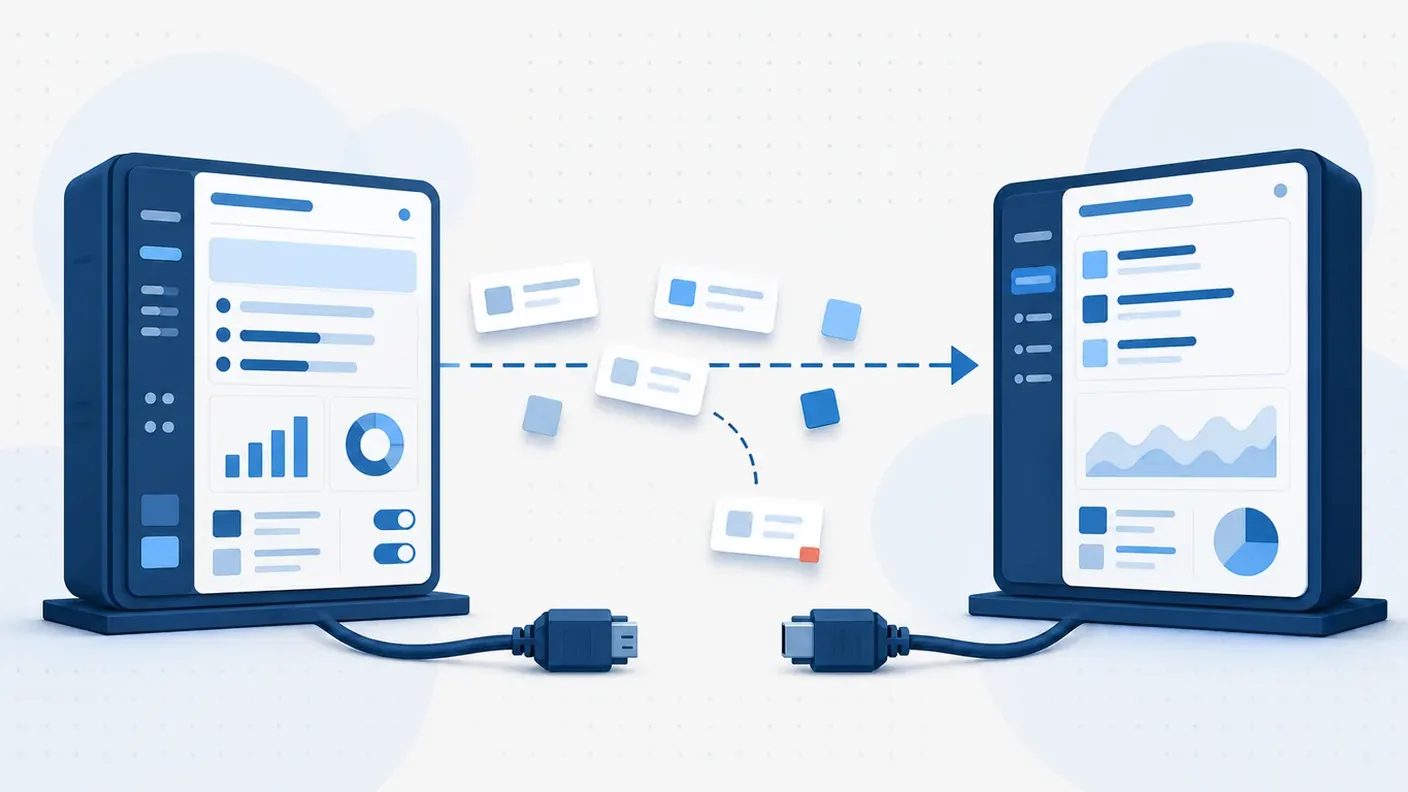
Many resellers we speak to run two systems. Sales live in one. Billing lives in another. Nobody planned it that way. It often happened one sensible decision at a time.
The cost of that split is real, but it rarely shows up as a line on anything. It hides in re-typed tariffs, in quotes that do not match invoices, and in renewals nobody spotted until the customer had already gone.
Key terms in this article
What does CRM mean?
CRM (customer relationship management) is software that tracks your dealings with customers and prospects. Who they are, what you quoted, what was discussed, and what happens next. Most CRM tools are built for generic B2B sales rather than telecoms.
What does quote-to-cash mean?
Quote-to-cash is the whole run from first quote to money in the bank. Quoting, winning the deal, provisioning the service, invoicing it, then collecting the payment. The more systems that run sits across, the more places it can break.
What does MRR mean?
MRR (monthly recurring revenue) is the predictable part of your monthly turnover, from recurring services such as line rentals and hosted seats. Usage, one-off charges and tax normally sit outside it, so say what you have included when you report it. Lenders and buyers look at MRR first.
What does churn mean?
Churn is customers or services leaving you, usually quoted as a percentage of the base you started the period with. Replacing that revenue costs most resellers more than keeping it would have done, though how much more depends on how you win customers.
Why Do Resellers End Up With Two Systems?
Because both decisions were reasonable at the time. You needed somewhere to track sales conversations, so you picked a CRM. You needed to rate calls and raise invoices, so you picked a billing platform. Neither choice was wrong.
The problem is what sits between them. Somebody has to move information from one to the other, and that somebody is usually a person.
Key Takeaways
- The cost of two systems is re-keyed data, out-of-date copies and missed renewals, none of which appear on a budget line
- The PSTN fully switches off on 31 January 2027, which makes contract renewals unusually urgent through 2026 (Openreach, 2026)
- An integration reduces the typing, but how current the copy is depends on how often it runs and how failures are handled
- The questions that matter most to a reseller need billing data, whether through an integration or a shared platform
Where the Time Actually Goes
Watch how a won deal travels through a reseller with two systems.
A salesperson types the customer into the CRM. They build a quote, often in a spreadsheet, because the CRM does not understand tariffs. The customer says yes. Someone then types the same customer into the billing platform, and types the tariff a second time.
That second typing is where the money leaks. Not dramatically, and not every time. But a transposed digit in a call rate does not announce itself. It quietly under-bills that customer every month until somebody notices, which might be a year.
None of this is anyone’s fault. It is just what happens when the same information has to exist in two places.
The Quote That Does Not Match the Invoice
This is the one customers actually notice, and it costs you more than the money involved.
A quote built outside the billing system is a document. It represents what someone believed the price would be. The first invoice is what the billing engine calculates. When those two disagree, you are having an awkward conversation in the first month of a new relationship.
Usually the gap is small. A pro-rated first month, a connection charge nobody mentioned, a bundle that rates differently in practice. Small is enough. The customer has just learned that your paperwork cannot be relied on.
Renewals Are the Expensive One
Ask a reseller which contracts end in the next 90 days and how much revenue that represents. If those dates live only in billing, answering means running an export or building a report first.
The contract end dates exist. They are sitting in the billing platform, attached to the services. The trouble is that renewals are a sales job, and sales are working in a different system that has never seen those dates.
So renewals get tracked by hand, or by memory, or not at all. A contract lapses onto a rolling monthly term. A competitor rings at the right moment. The revenue disappears without anyone having decided to lose it.
The PSTN switch-off on 31 January 2027 sharpens this considerably. Between now and then, an unusual proportion of your base needs a conversation about what replaces their existing service. If you cannot list who is out of contract and what they are worth, you will have those conversations late, or your competitor will have them first. Our guide to the switch-off covers what changes and when.
Chasing Money With Yesterday’s Figures
Credit control has the same shape of problem, with a sharper edge.
If your chasing runs off an export, you are working from a snapshot. Somebody pays on Tuesday morning, the list was pulled on Monday, and they get a reminder anyway. How long that window stays open depends on your integration and how quickly payments are recorded.
Chasing from the billing ledger itself removes that whole category of error. SAFE CRM sweeps it daily and checks again that an account is still eligible before anything goes out, so there is no second copy of the balance to go stale. Payments still take time to reach you and be recorded, but nobody is chasing from Monday’s list on Thursday.
Why an Integration Only Gets You Halfway
The usual answer is a connector between the two systems. It genuinely helps, and it is better than typing. But be clear about what it does and does not solve.
An integration reduces the typing. It does not remove the delay. Most run on a schedule rather than instantly, so there is still a window where the two systems disagree. Connectors also fail quietly, which means somebody has to own the monitoring and the retries, or both systems end up confidently wrong in different directions.
There is also a limit to what any connector can carry. It can copy a customer name and an address easily enough. It cannot make a generic CRM understand what a fixed-fee tariff does to a margin.
What to Look For Instead
If you are reviewing how your sales and billing fit together, these are the questions worth asking.
Can I see every contract ending in the next 90 days, with the revenue attached, without building anything? Does a quote use the same tariffs the billing run will use? When a deal is won, does anyone re-type it? Does credit control work from live balances or from an export? Can I see the margin on a deal before I sign it, not after?
If the honest answer to most of those is no, the gap between your two systems is costing you more than you can currently see.
How Safe Online Billing Helps
We have built telecoms billing for UK resellers since 2005, and we kept seeing the same split. So we closed it.
SAFE CRM puts deals, quotes, proposals, renewals, follow-up sequences and credit control inside the SAFE platform itself. Not connected to it. Inside it. Sales and billing share the same customer and product records, so a quote is built from the tariffs the billing run will use, and the products on a won deal carry through to go-live without anyone entering them twice. The usual rules still shape the first invoice: usage, tax, pro-rating, when the service actually went live, and anything that changed since.
That makes the renewals radar possible with no data entry at all, because the contract dates were already yours. It is launching soon as a paid add-on, and early access is open now.
If you would like to see it against your own customer base, get in touch. We will give you a straight answer about whether it would help.