
Key terms in this article
What is credit control?
Credit control is the work of getting paid on time. It covers checking who you extend credit to, setting payment terms, chasing overdue invoices, holding accounts and deciding when to stop supplying a customer.
What is the Small Business Commissioner?
The Small Business Commissioner is a UK statutory officer who helps small firms settle payment disputes with larger customers. The Commercial Payments Bill would give the role powers to investigate late payers and fine them, but that is not law yet.
What is aged debt?
Aged debt is money owed to you, grouped by how overdue it is. The aged debt report is the document most credit control work runs from.
What Is the Credit Control Process?
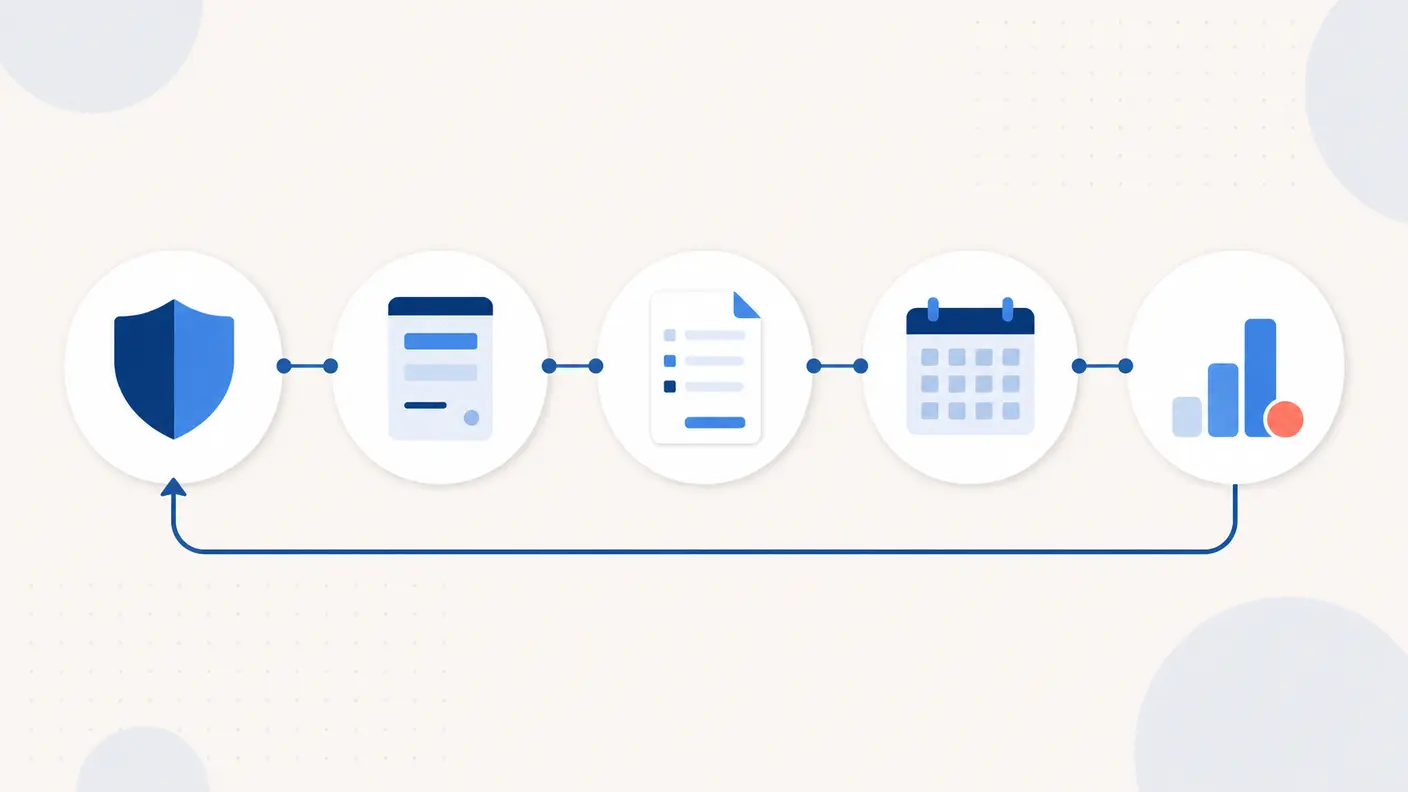
The credit control process is the repeating routine a business uses to get its invoices paid. It runs in five stages: decide who gets credit, agree the terms, invoice accurately and promptly, chase on a fixed schedule, and escalate when chasing stops working.
Most small businesses have some version of stages three and four, and skip one, two and five. That is usually where the problem is.
Key Takeaways
- Credit control has five stages, and most businesses only run the middle two
- The work starts before the sale, not when the invoice goes overdue
- Fixed intervals beat firm wording, because customers learn your pattern
- Escalation only works if you actually follow through
- The government puts the cost of late payment at £11 billion a year, and says 38 businesses close every day because of it (GOV.UK, 2026)
- On a qualifying overdue commercial debt you can claim interest and fixed recovery costs (GOV.UK, 2026)
- Someone has to own it, or it does not happen
Stage 1: Decide Who Gets Credit
Extending credit is a decision, even when nobody makes it deliberately. Every invoice with payment terms on it is an unsecured loan to that customer.
For a new customer of any size, the basic checks are quick:
- Companies House. Confirm the company exists, is not in liquidation, and that filings are up to date. Overdue accounts are a signal worth noticing. Searching is free (Companies House, 2026).
- A credit check. Proportionate to the exposure. For a small monthly bill, Companies House may be enough. For a large contract, use a credit reference agency.
- Trade references. Old fashioned and still useful for larger accounts.
- Their payment record. Larger UK companies have to publish payment practice reports, so a big customer’s record may already be public. The reports are free to search (GOV.UK payment practices service, 2026).
Set a credit limit that reflects what you find, and revisit it when the customer’s spend grows.
From our experience: the accounts that turn into serious bad debt are very rarely the ones that looked risky at the start. They are usually customers who grew gradually, whose credit limit was set years ago against a much smaller monthly bill and never looked at again. An annual review of limits catches more than any amount of checking at sign-up.
Stage 2: Agree the Terms Clearly
Terms only help if the customer has actually seen them and cannot reasonably claim otherwise.
- Put payment terms on the order or contract, not only on the invoice.
- State the due date as a date, not as a period. “Due 28 August 2026” removes an argument that “30 days” does not.
- Say how you want to be paid, and make that the easiest option.
- Say what happens if payment is late. If your contract sets out its own interest remedy, that can replace the statutory one, so word it deliberately.
You do not need a clause to claim statutory interest. It applies anyway, unless your contract offers a different remedy that is substantial. The Commercial Payments Bill would make statutory interest mandatory and cap standard terms at 60 days, with narrow exemptions. It went to Parliament in May 2026, is not law yet, and will not apply to past payments (GOV.UK, 2026). We covered the announcement in our King’s Speech update.
Stage 3: Invoice Properly
More overdue invoices are caused by bad invoicing than by bad customers. An error delays payment even when the customer fully intends to pay.
- Invoice quickly. Your cash gap starts when you deliver the service, not when you get round to billing for it.
- Get the details right. Correct purchase order number, correct contact, correct address, correct line detail. Every error is a legitimate reason for the customer to wait.
- Send it to a person who can pay it. An invoice sitting in a shared inbox nobody owns is not really an invoice yet.
- Check it arrived. For larger invoices, a short confirmation email is worth the minute it takes.
Stage 4: Chase on a Schedule
This is the part most people mean when they say credit control. A workable sequence on 30-day terms:
- A few days before due date. A courtesy reminder. Cheap, and it prevents a surprising number of overdue invoices.
- Day 1 to 3 overdue. A short, friendly note. Assume an oversight.
- Around day 14. A firmer note stating the amount, the original due date and how to pay. Ask for a payment date if they cannot pay now.
- Around day 30. A phone call. Written reminders have usually stopped working by now. Check for a dispute or a payment problem before you escalate.
- Around day 45 to 60. A formal notice setting out what happens next.
Those timings are an example, not a legal timetable. Consumer debts need more care than business ones. If you are a telecoms provider, build in the protections for customers in vulnerable circumstances that Ofcom expects (Ofcom, 2026).
The two rules that make it work:
Fix the intervals. Customers learn your pattern. Predictable dates get paid; improvised ones get ignored.
Write down what was said. Every promise to pay, every dispute raised, every call. Without a record you restart the conversation each time, and the customer knows it.
If you want the detail of what the escalating sequence looks like, and why American software calls it something else, see our post on what dunning means.
Stage 5: Escalate, and Mean It
Escalation is where most processes quietly fail. The options, roughly in order:
- Hold the account. For a service business this is the strongest lever you have, and much stronger than interest. It has to be a real hold, applied when you said it would be.
- Agree a payment plan. For a customer with a genuine cash problem who you want to keep. Put it in writing, and treat a missed instalment as a breach rather than a renegotiation.
- Claim statutory interest, where it applies. The Late Payment of Commercial Debts (Interest) Act 1998 gives you 8% above the Bank of England base rate (GOV.UK, 2026), plus £40, £70 or £100 in fixed recovery costs depending on invoice size (GOV.UK, 2026). A rate set in your own contract displaces it, except with a public authority, where you cannot go below the statutory rate. The rate comes from the 30 June or 31 December before the debt went overdue, not today’s rate, so our late payment interest calculator works it out from the due date. In practice this is a last resort for accounts in dispute rather than routine policy, for reasons we set out in why statutory interest rarely works.
- Approach the Small Business Commissioner. If a larger customer is the problem, the Commissioner’s office is an independent public body set up under the Enterprise Act 2016, and it may be able to help with an unresolved payment dispute against a larger customer (Small Business Commissioner, 2026).
- Formal recovery. A letter before action, then the small claims route or a collection agency. Take advice before starting, and be realistic about cost against the balance.
An escalation you do not carry out is worse than no escalation, because it teaches the customer that none of your deadlines are real.
Preventing the Problem Instead
Two structural changes do more than any amount of chasing.
Direct Debit. Of everything on this page, this is the change we see make the most difference. You collect on the agreed date instead of waiting for the customer to decide. Collections can still fail or be returned, so it is not magic, but it changes who holds the timing. Our payment collection service covers how that works in practice.
Pre-pay with automatic top-up. For customers where credit is not appropriate, the account is funded before the service is used. That usage never becomes a debt to chase, though a failed collection or an account with no usable payment method still needs someone to look at it. We have written about how that works on the product site in our post on auto top-up for pre-pay customers.
Measuring Whether It Works
Two numbers, tracked monthly.
The aged debt report gives you the detail: which customers, which invoices, how late. Watch the balance sitting beyond 90 days in particular.
Debtor days gives you one figure you can trend and put in front of a lender or a board. It is an estimate, so compare it with your own terms and your own past figures, then use the aged report to explain any change.
If the over-90 balance is falling and the gap between your terms and your debtor days is narrowing, the process is working.
Frequently Asked Questions
What are the 5 C’s of credit control?
The five Cs are character, capacity, capital, collateral and conditions. They are a lending framework used to assess whether a borrower is likely to repay, covering their track record, their ability to pay, their financial reserves, any security offered and the wider economic circumstances (Investopedia, 2026). They come from bank lending rather than trade credit, but the first three translate usefully when you are deciding how much credit to extend to a new customer.
Who should be responsible for credit control?
One named person, whoever that is. In a small business it is often the office manager or the owner rather than a dedicated credit controller, and that works fine. What does not work is treating it as a shared responsibility, because a task that belongs to everyone gets done by nobody. The role needs a routine, a worklist and the authority to put an account on hold.
How soon can I start chasing an overdue invoice?
Immediately. Once the due date has passed the invoice is late, and a reminder on day one is entirely reasonable. Chasing early is not aggressive, and businesses that do it are usually paid before businesses that wait. Your statutory right to interest also begins the day after the debt becomes overdue, whether or not you choose to claim it.
Making It Run Itself
Most of this process is routine work that has to happen on time, every time. That makes it a good candidate for automation, and a poor candidate for somebody’s memory.
The credit control side of our CRM sweeps the invoice ledger every day. It builds the worklist, works through your reminder steps, and keeps the conversation history on the same record as the billing. Nothing goes out without a final check that the account is still eligible, so a customer who has just paid is not chased.
If you would like to talk through your own process, the contact form is the way in.