
Key terms in this article
What is number porting?
Number porting is the process of moving a phone number from one provider to another while keeping the same digits. The number transfers; the wholesale account that owns it changes. Porting fees may be charged by the losing provider, the gaining provider, or both, under the framework set out in Ofcom General Condition C7 on switching and number portability.
What is a port-out charge?
A port-out charge is a fee that a losing wholesale provider raises when one of their resold numbers moves away. The charge usually appears on the reseller’s wholesale invoice some time after the port itself has completed, depending on the wholesaler’s billing cycle.
What is wholesale pass-through?
Wholesale pass-through is the practice of billing your end customer for a cost you have incurred from your upstream provider, at cost or with a markup. Pass-through requires a contract clause permitting it and usually requires the cost to be itemised on the customer invoice.
A reseller we know recently got a surprise bill from their wholesale provider: port-out charges for a customer’s number range, dated several weeks after the customer had already moved to a competitor. The customer was long gone. The reseller had no clause in the original customer contract that let them invoice for charges incurred after the relationship had ended. They absorbed the cost. It was not a small number.
If you run a telecoms reseller business, this will happen to you sooner or later. The combination of a customer leaving, the losing wholesaler’s billing cycle, and the absence of a forward-looking contract clause is a quiet way to lose margin. This post covers the clause to add now, and the related warning to flag when you win a new customer from somewhere else.
Key Takeaways
- Port-out charges from wholesale providers can land weeks or months after the customer has actually left
- Customer contracts need an explicit clause allowing pass-through of porting and end-of-service charges even after the relationship ends
- Number porting in the UK is governed by Ofcom General Condition C7 on switching and number portability
- When you win a customer from another reseller, their losing provider may bill them for the port-out
- A short warning to the new customer at sign-up protects the relationship from a surprise bill arriving later
- A billing platform with one-off line items and a clean description field is the practical tool for handling late-arriving pass-through charges
What Goes Wrong With Porting Fees
The pattern that catches resellers out most often:
- End customer decides to leave the reseller for a competitor.
- The competitor arranges the port. The customer’s service moves over.
- The original customer-reseller relationship ends.
- Several weeks or months later, the losing wholesaler sends a port-out charge to the reseller for the number range that moved.
- Reseller looks at their customer contract and realises there is no clause permitting them to invoice after the relationship has ended.
- Reseller absorbs the charge, or attempts a difficult conversation with a customer who is no longer a customer.
The fix is a contract clause, not a billing-system change. But the billing system is where the clause has to land cleanly when the charge eventually arrives.
The Contract Clause to Add Now
A short paragraph in your standard contract template that does the following:
- Names port-out fees, end-of-service charges, number range release charges and similar wholesale costs as items you can pass through.
- States that pass-through charges will appear on a final invoice or supplementary invoice after they are incurred, even if the main service has ended.
- Notes that charges may arrive weeks or months after the work, depending on wholesale invoicing timing.
- Sets a reasonable upper time window (for example, 12 months) after which you will not invoice for a wholesale charge that has not yet appeared.
This is not legal advice, and your solicitor should sign off on the actual wording, but the principle should be visible to the customer at signature, not buried in a schedule they never read.
From our experience: the customer who got the surprise bill was not unreasonable. They were unprepared, and so was their reseller. A short paragraph in the original contract, signed eighteen months earlier, would have made it a non-event. The lesson is to add the clause now, before the next customer leaves.
The Warning When Winning a Customer
The reverse perspective is just as important. When you win a customer from another reseller, their losing provider may have a similar port-out clause in its own contract, and the same kind of late-arriving charge waiting to fall out of its wholesale billing cycle. Your new customer may not know it is coming. Volumes of number porting are unusually high in 2026 as businesses migrate ahead of the PSTN switch-off at the end of January 2027, which makes the onboarding warning more important than usual.
A short note in your onboarding pack, ideally read by the customer before they trigger the port:
- The customer should check their existing contract for any port-out, exit or end-of-service fees.
- The losing provider’s final invoice may arrive weeks after the service moves; the customer should expect it and budget for it.
- The fee is not something the new provider can absorb or negotiate; it sits with the losing provider’s contract.
You are not creating the charge by mentioning it. You are protecting the new relationship from a “why didn’t you warn me?” conversation three months in.
Pass-Through Charges on the Invoice
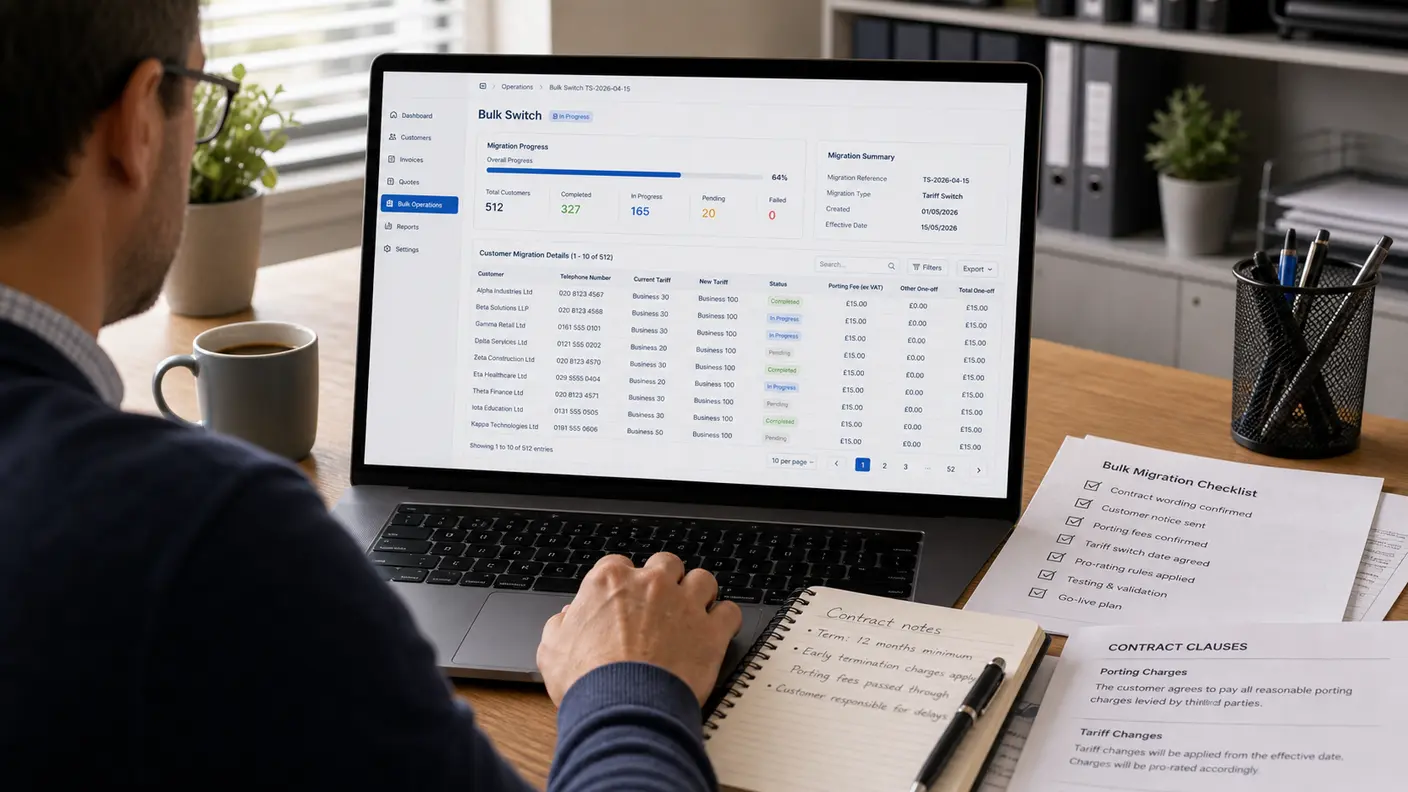
When a wholesale port-out fee lands on your account, it goes on the customer’s account as a one-off charge and appears on the next invoice (final or supplementary) as a separate line item. The description matters: “Port-out fee, passed through from wholesale provider” reads as transparent. “Misc charge” reads as suspicious.
If you are passing through with a markup, the markup logic should sit in your tariff configuration rather than as a manual fudge per invoice. For customer accounts that have already closed, the one-off charge re-opens them long enough for the final invoice to issue, then closes them again. The same pass-through principle applies to WLR rental rises from Openreach: three staged increases in April, July and October 2026, each of which arrives on your wholesale invoice before it reaches your customer.
Pricing Models When You Win the Customer
If you are the gaining reseller, you also need to decide whether and how to charge for porting numbers in. Three patterns we see:
Flat bulk fee. A single charge for the port-in, covering up to a stated number of DDIs or a number range. Simple to invoice, easy for the customer to understand.
Per-number fee. An itemised charge per DDI ported. Useful when the customer is moving an unusually large or small block and a flat fee would be unfair either way.
Free as a loss-leader. Some resellers absorb the port-in cost entirely as the deal-sealer. Worth doing on big-ticket customers; not worth doing routinely.
The choice is commercial, not technical. Any decent billing platform will support any of them.
How SAFE Billing Platform Handles It
On the platform side, SAFE adds the pass-through charge to the customer account as a one-off line item, formats the description as you set it, applies any configured markup, and pushes the result to the next invoice. The customer-facing wording, the contract clause and the onboarding warning all sit on your side.
The billing run guide on billingplatform.uk covers the monthly cycle and where one-off charges fit. The customer accounts and number management guide covers DDI provisioning and reassignment.
For the wider compliance picture including Ofcom billing rules and contract notification requirements, see our UK telecoms compliance guide.
For a walk-through against your own contract template and porting workflow, the contact form is the quickest way in.