
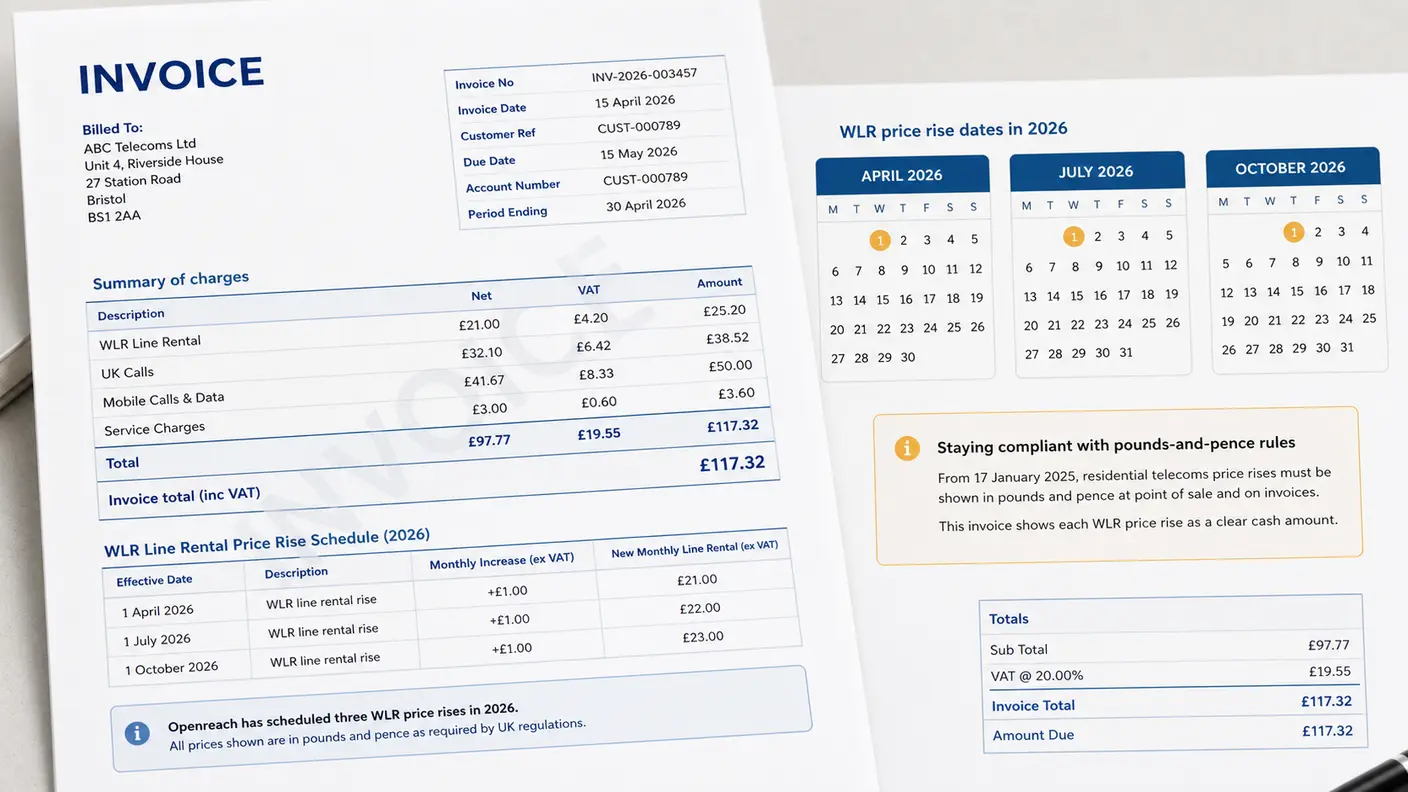
Openreach raised Wholesale Line Rental (WLR) three times in 2026, in April, July and October, to encourage migration off copper before the PSTN closes on 31 January 2027. Basic rental has doubled over the year, from £10.65 to £21.30 a month ex VAT. For a reseller still carrying WLR, each rise raised the same questions: whether the contract allows the increase to be passed on, how to tell the customer, and whether the customer should move to an IP service instead.
Key Takeaways
- WLR basic rental rose by 20% in April 2026 and by a further 40% of the original price in each of July and October, doubling it (Comms Council UK, 2025)
- Passing a rise on depends on the contract; for residential and small business customers, a rise the contract does not set out in pounds and pence is a contractual modification with notice and exit rights
- Show the old price, the new price and the date on the invoice, with a short reason
- Lines still on WLR after 31 January 2027 move to Emergency Voice Access at £35 or £38.60 a month wholesale, so migration remains the better outcome
- Annual inflation-linked rises in older contracts are a separate change and need separate wording
Key terms in this article
What are the Ofcom pounds-and-pence rules?
The Ofcom pounds-and-pence rules are amendments to General Condition C1, in force since 17 January 2025. Where a new contract provides for the monthly price to change during the contract, the new price and its date must be stated in pounds and pence at point of sale, not as a percentage tied to CPI or RPI. They cover residential customers and microenterprise, small enterprise and not-for-profit customers.
The 2026 Rises
Openreach set the increases as percentages of the WLR price at the start of the year (Comms Council UK, 2025):
| Date | Change | WLR basic rental (ex VAT) |
|---|---|---|
| Before April 2026 | £10.65 | |
| 1 April 2026 | +20% | £12.78 |
| 1 July 2026 | +40% of original | £17.04 |
| 1 October 2026 | +40% of original | £21.30 |
Other WLR products rose on the same pattern, so check Openreach’s pricing notices for the exact figures on each product you carry before quoting amounts to customers. Openreach paired the rises with free or discounted SOGEA connections to support migration.
Passing the Rises On
Whether you can pass a wholesale increase on, and how, depends on the contract with each customer and which category the customer falls into.
For residential customers and microenterprise, small enterprise and not-for-profit customers, a rise already set out in the contract in pounds and pence, with its date, can be applied as agreed. A rise the contract does not set out that way is a contractual modification under General Condition C1: the customer must receive at least one month’s notice and can leave without penalty (Ofcom statement on inflation-linked price rises, 2024). For many WLR customers, that exit right makes the notice a natural point to offer an IP replacement.
Larger business customers fall outside these rules, and the position depends on their contract terms. Take legal advice on the wording for your own contracts. The pounds-and-pence guide on billingplatform.uk covers the requirements in more detail.
Presenting the Change
Whatever the contractual basis, a wholesale-driven increase is easier for a customer to accept when it is stated plainly:
- Show the old price, the new price and the date, either in a cover note or against the line item, rather than leaving the change in a revised rate.
- State it in pounds and pence. For customers in scope of Ofcom’s rules this is required for new contracts; for others it is still the clearest form.
- Give the reason once and briefly, for example that Openreach has increased the wholesale price of the line ahead of the PSTN closure.
Annual Contract Rises
Many reseller contracts also contain an annual inflation-linked rise. That is a separate change, with its own contractual basis and date. Contracts signed before 17 January 2025 keep their original terms until they end or renew, but new contracts with residential and small business customers must state any planned rise in pounds and pence.
Where a customer receives several notices close together, such as an annual uplift, a WLR pass-through and a renewal quote, each needs its own explanation. Sequencing them, or combining the WLR rise with a migration offer, reduces the number of separate letters the customer receives.
After 31 January 2027
Lines still on WLR after the PSTN closes are expected to move to Emergency Voice Access (EVAc) from 1 February 2027, a limited fallback service. Openreach has set its wholesale price at £35 a month for WLR3 Basic and £38.60 for WLR Premium, ex VAT, well above even the doubled WLR rental (ISPreview, 2026). Business customers should not plan around it. Our PSTN switch-off guide covers the remaining migration work.
When customers move, watch for wholesale port-out charges that arrive after the move; the porting fees pass-through guide covers the contract terms that let you recover them.
How SAFE Billing Platform Handles It
SAFE applies tariff changes from their effective date, with pro-rating across the change, so a wholesale rise reaches the right customers’ invoices in the next billing run. Contract wording sits with you, but SAFE can generate per-customer price-rise letters from your own template, selecting recipients by their recorded Ofcom Protection Class. The billing run guide covers the monthly cycle, and the customer accounts guide covers the bulk-change tools.
Frequently Asked Questions
Do I need to tell customers about WLR price rises under Ofcom rules?
For residential customers and microenterprise, small enterprise and not-for-profit customers, it depends on the contract. A rise the contract already sets out in pounds and pence, with its date, can be applied as agreed. A pass-through the contract does not set out that way is a contractual modification under Ofcom General Condition C1: the customer needs at least one month’s notice and can leave without penalty. Larger business customers fall outside these rules, though stating the change in pounds and pence is still clearer. Take legal advice on the wording for your own contracts.
How much did WLR rental rise in 2026?
WLR basic rental rose from £10.65 to £21.30 a month ex VAT: 20% in April 2026, then a further 40% of the original price in July and again in October. Other WLR products followed the same pattern; Openreach’s pricing notices give the exact figures for each product.
What happens to WLR after January 2027?
The PSTN closes on 31 January 2027. Lines still on WLR are expected to move to Emergency Voice Access from 1 February 2027, a limited fallback at £35 a month wholesale for WLR3 Basic and £38.60 for WLR Premium. Customers should migrate to an IP voice service, such as a SIP trunk or hosted PBX, before the deadline.
To review how a price change would run against your own tariffs and customers, arrange a demonstration.