
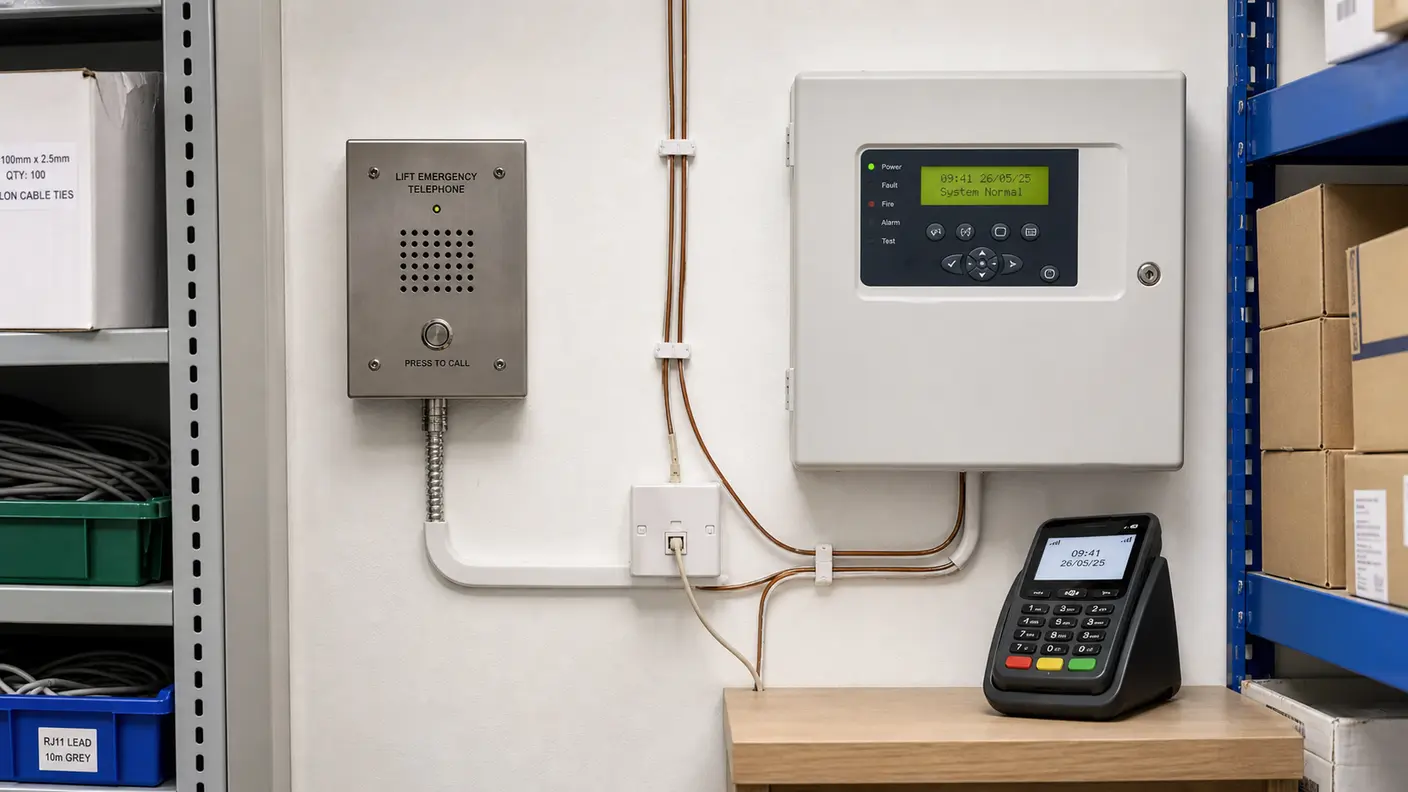
When a customer’s voice service moves from an analogue line to IP, the phone itself is usually the straightforward part. The harder part is everything else connected to the same copper line: lift emergency phones, monitored alarms, older card terminals, telecare units and door entry systems. These were often installed years apart by different suppliers, and the customer may not know which of them depend on the line.
The voice provider is not usually responsible for these devices, but it is often the first supplier the customer talks to about the switch-off. With the PSTN closing on 31 January 2027, asking about them during a voice migration is the most reliable way to find them in time.
Key Takeaways
- The PSTN closes on 31 January 2027, and lines left on WLR move to a limited Emergency Voice Access service from 1 February (Openreach, 2026)
- Lift emergency alarms must continue to meet BS EN 81-28, which usually means an IP or SIM-based alarm with battery backup
- Monitored intruder and fire alarms may need a new signalling path, and insurers often make the alarm path a policy condition
- Older dial-up card terminals need replacing with IP, Wi-Fi or 4G models
- Telecare alarms need assessing with the alarm provider; Openreach offers a migration service for telecare users
Key terms in this article
What is an analogue terminal adapter?
An analogue terminal adapter (ATA) connects an analogue device, such as a phone or some alarm panels, to an IP service by presenting a standard phone socket. Not every device works reliably through one, particularly equipment that signals to a monitoring centre.
What is BS EN 81-28?
BS EN 81-28 is the British and European Standard for remote alarms on passenger and goods-passenger lifts. A lift alarm must continue to meet it after the PSTN closes, which usually means a battery-backed IP or SIM-based alarm rather than an analogue line.
Lift Emergency Phones
A lift in service needs a working emergency alarm that meets BS EN 81-28, traditionally connected to a monitoring centre over an analogue line. After the switch-off, the replacement is normally an IP or SIM-based alarm with battery backup, fitted by the lift maintenance company. The cost depends on the lift and the monitoring contract, and maintenance companies set the timetable, so the customer needs to contact them directly.
The voice provider’s part is to make sure the customer knows the lift alarm is a separate job from the phone system, and who to speak to.
Monitored Intruder and Fire Alarms
Monitored alarms send signals to an alarm receiving centre. Older panels use the analogue line; newer ones use IP, a mobile network, or both as a dual path. A customer who has not replaced their alarm for many years may not know which they have.
For commercial premises, the alarm path is often a condition of the insurance policy, so a failed path can affect cover as well as security. The alarm installer should confirm in writing whether the panel will keep working after the switch-off, and what upgrade it needs if not.
Card Payment Terminals
Most current card terminals connect over IP, Wi-Fi or 4G and are unaffected. Older terminals that dial out over a phone line will stop working. Replacement is usually simple, but the merchant services provider controls the timing, so a business that still has a dial-up terminal needs to arrange the change before it fails.
Telecare and Personal Alarms
Telecare alarms, such as the pendant alarms used by older and vulnerable people, are the most sensitive devices on the line, because a failure can affect someone’s safety. Some analogue alarms do not work reliably over digital lines without changes.
Where a customer owns telecare equipment as part of its service, such as a housing provider or care organisation, the migration needs planning with the alarm provider and, where relevant, the local authority. Openreach offers a migration service for telecare users so that their devices keep working, and the TSA publishes guidance for the sector.
Other Devices
Other devices that may dial out over a copper line include:
- door entry systems that call out
- fax machines, still used in parts of legal and healthcare work
- franking machines that dial in for credit
- building management systems that send fault alerts
- auto-diallers on shutters and gates
Some of these sit in areas the customer does not control directly, such as a landlord’s fire alarm in shared premises, so the list needs checking with the building owner as well.
A Checklist for Customers
A reseller can give customers a short checklist alongside a voice migration:
- Walk each site and note anything that may dial out: lift, alarm, fire panel, card terminal, telecare, door entry, fax and franking machine.
- For each device, identify the installer or service provider and ask in writing whether it will work after 31 January 2027.
- For alarms and lifts, check the insurance policy and maintenance contract for conditions on the alarm path.
- Book any upgrades now. With four months to the deadline, installers’ and engineers’ lead times are the main constraint.
- Keep the list, with the supplier for each device, for future reference.
How This Fits With the Voice Migration
A customer moving to SIP trunks or hosted PBX sees the voice change on their phone bill, but the costs of moving other devices fall elsewhere. Raising those devices during the voice migration helps the customer budget for the whole change, and avoids an alarm or lift failing after the voice service has moved.
The PSTN switch-off resellers’ guide covers the wider migration and what happens after the deadline. The WLR price rises post covers the 2026 wholesale increases.
Frequently Asked Questions
Will a monitored fire alarm stop working after the PSTN switch-off?
A panel that signals only over the analogue phone line will stop working when that line is withdrawn. Panels using IP or mobile signalling, or a dual path, are not affected in the same way. The alarm installer can confirm which applies and what upgrade is needed.
Do card payment terminals need replacing when copper goes?
Only older terminals that dial out over a phone line. Most current terminals use IP, Wi-Fi or 4G. The merchant services provider can confirm which type a business has.
What does replacing a lift emergency phone involve?
The lift maintenance company usually replaces the analogue connection with an IP or SIM-based alarm with battery backup that meets BS EN 81-28. Cost and timing depend on the lift and the monitoring contract, so the customer should contact their maintenance company now.
To see how SAFE bills a customer base with legacy lines and new IP services on the same invoice during migration, arrange a demonstration.